
Overview – Simons and Chabris (1999)
Simons and Chabris (1999) is a key study in the cognitive area of psychology that investigated inattentional blindness – the inability to notice something unexpected when attention is focused on another task. The study showed that people will often fail to notice a highly visible event if they are concentrating on something else. It became well known because of its unexpected ‘gorilla’ event: Participants watched people passing basketballs and were asked to count the passes made by one team and, during the video, a person in a gorilla costume walked through the scene. Many participants didn’t notice the gorilla even though it was clearly visible. This shows that simply having an object within our visual field does not necessarily mean that we consciously perceive it.
You can jump to different sections of this article via the links below:
- Aim
- Method (sampling and procedure)
- Results
- Conclusions
- Evaluation and methodological issues
- Relation to other core cognitive psychology studies
Simons and Chabris (1999)
Aim
The aim of the study was to investigate whether people fail to notice an unexpected visual event when their attention is focused on another task (inattentional blindness).
Previous research had already shown that people often won’t notice unexpected events when they are concentrating on another visual task. For example, Neisser and Becklen (1975) showed participants overlapping transparent videos of people playing different ball games and asked them to focus on one of the events. Participants often failed to notice what was happening in the other video. Simons and Chabris used a similar technique of showing participants transparent overlapping visual events but built on this earlier research by also investigating whether inattentional blindness also occurs in a more life-like video where the visual task and unexpected event were not transparent and overlapping.
The researchers also wanted to see if inattentional blindness was dependent on the difficulty of the task. They predicted that a more difficult monitoring task would place greater demands on attention and thus make participants less likely to notice the unexpected event.
The study also investigated whether people were more likely to notice an unexpected event if it was visually similar to the information they were already attending to. For example, the researchers compared an unexpected person carrying an umbrella with an unexpected person wearing a gorilla costume. The gorilla was visually very different from the basketball players, whereas the umbrella woman was more similar to the people already present in the scene.
Overall, the study was designed to investigate how focused visual attention limits what people consciously perceive.
Method
Simons and Chabris used a laboratory experiment with an independent measures design.
The main experiment used a 2 × 2 × 2 × 2 design. There were four independent variables (IVs) that produced 16 experimental conditions:
- Video type: the players and unexpected event were shown either:
- in a transparent video, where the different elements were filmed separately and superimposed
- in an opaque video, where all the actors were filmed together and could physically block one another.
- Unexpected event: participants either saw:
- a woman carrying an umbrella
- a person wearing a gorilla costume.
- Attended team: participants were instructed to watch either:
- the team wearing white
- the team wearing black.
- Task difficulty: participants completed either:
- an easy monitoring task, counting all passes made by the attended team
- a hard monitoring task, separately counting bounce passes and aerial passes made by the attended team.
The dependent variable (DV) was whether or not participants noticed the unexpected event. In other words, the researchers recorded the number of participants who reported seeing the gorilla or umbrella woman in each condition.
Participants and sampling
Participants took part in the experiment either voluntarily, in return for a large candy bar, or as part of a larger testing session for which they received payment (this could be described a form of opportunity sampling).
The characteristics of the recruited participants were as follows:
- 228 participants (referred to by the researchers as ‘observers’)
- (192 of whom were included in the main analysis)
- Mostly undergraduate students.
Note: Data from 36 participants was discarded. So this left 192 participants whose results were included in the main analysis.
Procedure
4 different 75-second video tapes were created. Each video showed:
- Two teams of three basketball players.
- One team wearing white shirts and one team wearing black shirts.
- The players moving around in an open area in front of three elevator doors.
- Players passing an orange basketball between members of their own team.
- Players also dribbling the ball, waving their arms and making other movements.
After approximately 44-48 seconds, an unexpected event occurred.
- In the umbrella woman condition, a tall woman carrying an open umbrella walked across the screen.
- In the gorilla condition, a shorter woman wearing a gorilla costume walked across the screen.
Both unexpected events lasted approximately 5 seconds. The players continued passing the basketball while the unexpected event occurred.
There were two different ways of presenting the videos:
- In the transparent condition, the white team, black team and unexpected event were filmed separately. The three video recordings were then superimposed using digital video editing.
- In the opaque condition, all seven actors were filmed at the same time. This meant that players and the unexpected event could physically pass in front of or behind one another.
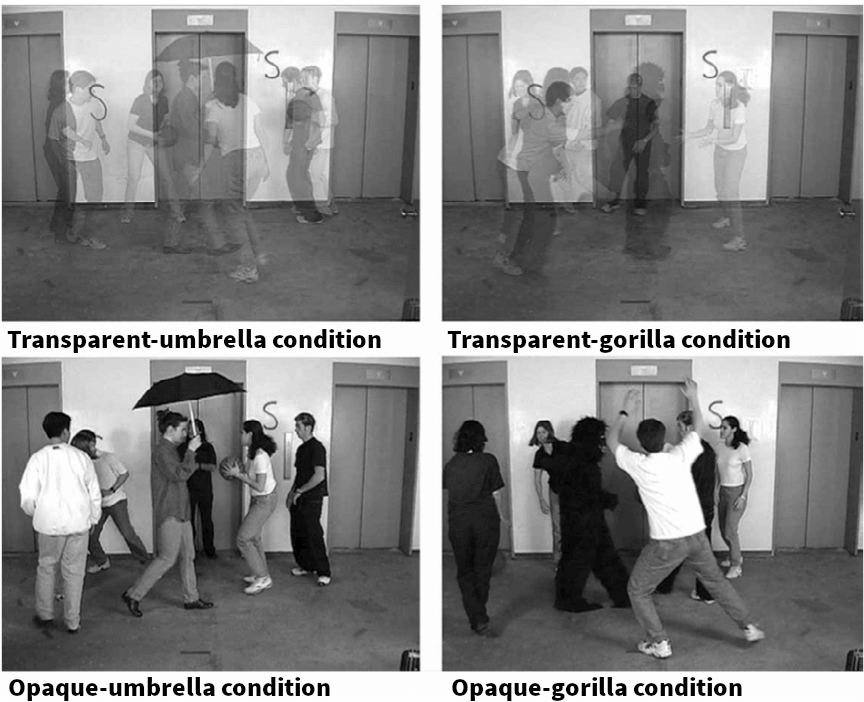
Participants watched the videos individually. Before watching, they were told that they would see two teams of three players passing basketballs. They were instructed to pay attention to either the white team or the black team.
They then completed one of two monitoring tasks:
- Easy task: silently count the total number of passes made by the attended team.
- Hard task: silently count the number of bounce passes and the number of aerial passes made by the attended team.
- The harder task thus required participants to keep track of two different types of passes, placing greater demands on attention.
Immediately after watching the video, participants wrote down their pass count or counts. They were then asked questions about what they had seen, including whether they had noticed anything unusual, whether they had noticed anything other than the six players, and whether they had seen a gorilla or a woman carrying an umbrella.
If participants said that they had noticed the unexpected event, they were asked to describe what they had seen.
Participants were also asked whether they had previously taken part in a similar experiment, heard about the experimental procedure, or heard about the general phenomenon of inattentional blindness. If they had, they were replaced and their data were discarded.
Each testing session lasted approximately 5-10 minutes.
The researchers also conducted a separate controlled observation: 12 different participants watched an opaque-style video in which the gorilla entered a live basketball-passing event, stopped in the middle of the players, faced the camera and thumped its chest before continuing across the screen. This enabled the researchers to investigate whether the failure to notice the gorilla was simply an artefact of the particular video presentation.
Results
The results showed that many participants failed to notice the unexpected event even though it was clearly visible.
Across all 192 participants:
- 54% noticed the unexpected event.
- 46% failed to notice the unexpected event.
There were also important differences between the experimental conditions:
| Easy task | Hard task | ||||
|---|---|---|---|---|---|
| White team | Black team | White team | Black team | ||
| Transparent | |||||
| Umbrella Woman | 58 | 92 | 33 | 42 | |
| Gorilla | 8 | 67 | 8 | 25 | |
| Opaque | |||||
| Umbrella Woman | 100 | 58 | 83 | 58 | |
| Gorilla | 42 | 83 | 50 | 58 | |
Participants were more likely to notice the unexpected event in the opaque condition than in the transparent condition:
- Opaque: 67% noticed the event.
- Transparent: 42% noticed the event.
Task difficulty also affected whether participants noticed the unexpected event:
- Easy task: 64% noticed the unexpected event.
- Hard task: 45% noticed the unexpected event.
The type of unexpected event also mattered with the umbrella woman being noticed more often than the gorilla:
- Umbrella woman: 65% noticed her.
- Gorilla: 44% noticed it.
The researchers also found an effect of the team participants were instructed to watch. The gorilla was noticed more often by participants who were watching the black team:
- Black team: 58% noticed the gorilla.
- White team: 27% noticed the gorilla.
However, there was little difference between the two groups in noticing the Umbrella Woman:
- Black team: 62% noticed the Umbrella Woman.
- White team: 69% noticed the Umbrella Woman.
This suggests that people may be more likely to notice an unexpected object when it is visually similar to the objects they are already attending to.
The researchers also carried out a separate controlled observation with a separate but similar video. In this observation, only 50% of the 12 participants noticed the gorilla in this version of the video, which was similar to the detection rate in the normal opaque/gorilla condition. This suggests that inattentional blindness was not simply caused by the gorilla being difficult to see in the original video.
The researchers discarded the data from 36 participants for several reasons:
- 14 already knew about the phenomenon or experimental paradigm.
- 9 reported losing count of the passes.
- 7 recorded incomplete or inaccurate pass counts.
- 5 gave answers that could not be clearly interpreted.
- 1 had a pass count more than three standard deviations from the mean of the other participants in that condition.
Overall, the findings showed that inattentional blindness is affected by the demands of the task and by the similarity between the unexpected event and the information being attended to.
Conclusions
Overall, Simons and Chabris concluded that inattentional blindness is a real and widespread feature of visual perception. People can fail to consciously perceive an unexpected event even when the event is clearly visible and occurs directly in front of them.
The findings suggest that information can reach the brain without becoming consciously perceived. In other words, simply having an object in our visual field does not guarantee that we will consciously notice it. Instead, attention appears to be necessary for conscious perception. Objects can pass through the centre of our visual field, and even remain visible for several seconds, without being consciously noticed if attention is focused elsewhere.
The researchers also concluded that inattentional blindness occurs with sustained, dynamic events. The unexpected events in the videos lasted around five seconds but many participants still failed to notice them. This suggests that inattentional blindness is not simply caused by an event happening very quickly.
The fact that many participants also failed to notice the unexpected event in the opaque condition was also important. In this condition, the players and the unexpected event were filmed together rather than being transparent and superimposed, as in the previous research of Neisser and Becklen (1975). Simons and Chabris showed that inattentional blindness also occurred when the events were filmed together in a more realistic scene. This suggests that the effect identified by Neisser and Becklen was not simply a result of the unusual or artificial appearance of superimposed videos.
Simons and Chabris thus argued that the study shows there is no conscious perception without attention. We do not automatically become consciously aware of everything that reaches our eyes. Instead, what we consciously perceive depends partly on where our attention is directed.
Factors affecting visual inattention
Simons and Chabris also found that the likelihood of noticing an unexpected event was affected by several factors:
- Task difficulty: Participants were more likely to notice the unexpected event when they completed the easy monitoring task than when they completed the hard task. This suggests that the more demanding the primary task, the more likely people are to experience inattentional blindness.
- Similarity to the attended information: Participants were more likely to notice the unexpected event when it was visually similar to what they were already attending to. The gorilla was noticed more often by participants watching the black team than those watching the white team, whereas there was little difference for the woman carrying the umbrella. This suggests that unexpected objects that are similar to the information receiving attention are more likely to be noticed.
- Visual conditions: Participants were more likely to notice unexpected events in the opaque condition than in the transparent condition. However, a substantial number of participants still failed to notice the event in the opaque condition. This shows that inattentional blindness can occur even in relatively realistic visual scenes.
Evaluation
Research methods and techniques
Laboratory experiment with an independent measures design. The researchers manipulated the video presentation, unexpected event, attended team, and task difficulty (IVs) then measured whether participants noticed the unexpected event (DV).
- High control and standardisation: The videos were carefully constructed and the procedure was standardised using a written protocol. This makes it more likely that differences in detection were caused by the experimental variables rather than uncontrolled factors.
- Independent measures: Each participant experienced only one experimental condition. This reduced the risk that participants would work out the purpose of the study from seeing different versions of the video.
- Artificial setting: Watching a short video while counting basketball passes is not the same as experiencing a real-life situation. This may reduce ecological validity because attention in everyday life is often more complex and less controlled.
- Controlled observation increased validity: The additional controlled observation using a similar video (also of a gorilla during a basketball passing sequence) and achieving similar results suggests the results of the experiment were not simply the result of the gorilla in the original video being hard to spot. This strengthens confidence in the findings.
Population and sampling
228 participants took part in the experiment, although 36 participants’ data were removed. The final sample therefore contained 192 participants, almost all of whom were undergraduate students.
- Relatively large final sample: 192 participants is a reasonably large sample for a laboratory experiment and allowed 12 participants to be placed in each of the 16 conditions.
- Student sample: Almost all participants were undergraduate students. This means the sample may not represent people of different ages, educational backgrounds or occupations and reduces how far the findings can be generalised.
- Different incentives: Participants took part voluntarily – for either a candy bar or as part of a paid testing session. This allowed the researchers to recruit a relatively large number of participants but the different incentives could potentially affect motivation and skew results.
Types of data
The study mainly produced quantitative data because participants were classified according to whether or not they noticed the unexpected event.
- Quantitative Data: The researchers recorded the number and percentage of participants who noticed the gorilla or umbrella woman in each condition. They also recorded participants’ pass counts.
- Objective and easy to compare: Detection rates provided clear numerical data that could be compared across the 16 conditions.
- Statistical analysis: The numerical data allowed the researchers to examine whether factors such as task difficulty and video type affected detection.
- Some qualitative information: Participants were asked to describe what they had noticed. This provided additional information about whether participants had genuinely seen and understood the unexpected event.
Representativeness and generalisability
The final sample contained 192 participants, but almost all were undergraduate students.
- Limited population: The student-heavy sample means the findings may not generalise equally to children, older adults, or people from different educational and occupational backgrounds.
- Large sample size: The use of 192 participants provides more confidence in the reliability of the overall pattern than would a very small sample.
- Replication across conditions: Twelve participants were included in each of the 16 conditions. This gave the researchers a systematic way of comparing the different experimental conditions.
Ethical issues
- Informed consent: Participants gave informed consent before taking part in the study.
- Deception: Participants were not told that the study was specifically investigating whether they would notice an unexpected event. This was necessary to prevent them deliberately looking for the gorilla or Umbrella Woman, but it involved withholding the true purpose of the study.
- Protection from psychological harm: The procedure was unlikely to cause psychological harm. Participants simply watched a short video and completed a counting task.
- Debriefing: Participants were debriefed at the end of the experiment and could watch the video again if they wanted to.
Overall, the study appears to have been ethically sound. Participants gave informed consent, the procedure was unlikely to cause harm, and they were debriefed afterwards.
Validity
- Internal Validity: Are the findings caused by the experimental variables rather than another variable?
- High control: The researchers carefully standardised the videos and instructions. This makes it more likely that differences in detection were caused by factors such as task difficulty or video type.
- Systematic manipulation: The 2 × 2 × 2 × 2 design allowed the researchers to compare the effects of several variables rather than simply comparing people who noticed the gorilla with people who did not.
- Control of prior knowledge: Participants who already knew about the phenomenon or experimental procedure were removed from the final analysis of results. This reduced the possibility that prior knowledge would affect detection and skew the results.
- External validity: Do the findings apply beyond the specific sample and setting used in the study?
- Support from previous research: The findings were consistent with Neisser and Becklen (1975), who also found that people could fail to notice a visual event when their attention was directed elsewhere. This replication across studies makes it more likely that inattentional blindness is a genuine phenomenon and suggests that the findings have some external validity.
- Ecological Validity: Do findings translate to the real world?
- Artificial task: Counting basketball passes while watching a video is a simplified laboratory task. Real-world attention is often more complicated and may involve movement, sound and multiple competing tasks.
- Naturalistic elements: The basketball players moved around in a relatively natural way and the unexpected events occurred within a dynamic scene. This makes the study more realistic than a very simple visual perception task.
- Controlled observation: The additional version of the study showed that inattentional blindness could occur even when the unexpected gorilla was presented in a more natural-looking live event.
Reliability
- Internal Reliability: Is the procedure consistent across all participants in this particular study?
- Highly standardised procedure: Participants received the same instructions and watched carefully prepared videos. The researchers also used a written protocol for the 21 experimenters.
- Standardised materials: The same basketball-passing actions and unexpected events were used across the relevant conditions, making the procedure consistent.
- External Reliability: Can the study be replicated at a different time and across different groups to produce consistent results?
- Easy to replicate: The researchers clearly described the procedure and created standardised videos (which means future researchers could present participants with the same visual information under controlled conditions). This makes the experiment very easy for other researchers to repeat.
Ethnocentrism
The study was conducted in the United States and involved mainly undergraduate participants.
- Weaknesses:
- Limited cultural representation: The sample provides limited evidence about whether inattentional blindness operates in exactly the same way across different cultures. Cultural differences in education, attention, technology use and everyday environments could potentially affect performance.
- Student-based sample: Almost all participants were undergraduates. This means the findings may not represent people from different educational, occupational or cultural backgrounds.
However, cognitive processes such as attention and perception are based on the functioning of the human brain. The basic mechanisms involved in visual attention are likely to be shared across humans. As such, inattentional blindness may be a largely universal human cognitive process, meaning that the findings are not necessarily ethnocentric simply because the participants came from one cultural setting.
Evaluation summary table
| Simons and Chabris (1999) | |
|---|---|
| Research methods and techniques | Strengths: The laboratory experiment had high control and standardisation. The written protocol and carefully prepared videos made it more likely that differences in detection were caused by the experimental variables and not extraneous variables. Weaknesses: The artificial nature of the task may reduce ecological validity. |
| Data types | The study produced mainly quantitative data. Detection rates and pass counts could be measured objectively, compared between conditions, and analysed statistically. |
| Representativeness and generalisability | Almost all participants were undergraduates, so the findings may not generalise to the wider population. However, the final sample of 192 participants was reasonably large and was evenly distributed across the 16 conditions. |
| Ethical issues | Participants gave informed consent, the procedure was unlikely to cause harm, and participants were debriefed afterwards. The true purpose of the study was not revealed beforehand but this was necessary to prevent participants deliberately looking for the unexpected event. |
| Validity | High internal validity: The standardised videos, instructions, and experimental conditions made it more likely that the experimental variables are what caused differences in detection rates. However, the artificial counting task may reduce ecological validity. |
| Reliability | The standardised videos, written protocol, and clearly defined procedure make the study consistent and easy for other researchers to replicate. |
| Ethnocentrism | The mainly undergraduate US sample provides limited evidence about cultural differences in inattentional blindness. However, the basic cognitive mechanisms involved in attention and perception are likely to be shared across humans, so the findings may have broad applicability. |
Relation to cognitive psychology more broadly
Simons and Chabris (1999) contributes to the cognitive area of psychology by demonstrating how attention affects perception. The study suggests that people do not consciously perceive everything that enters their visual field. Instead, attention selects some information for further processing while other information may be missed.
The table below summarises how this study compares with other core studies in this area and evaluates its contribution and current relevance:
| Simons and Chabris (1999) | |
|---|---|
| How the study relates to the cognitive area of psychology | Simons and Chabris contributes to the cognitive area by demonstrating that attention influences conscious perception. People can fail to notice clearly visible events when their attention is focused elsewhere. |
| Comparison with Grant et al (1998) |
Similarities:
Both studies investigate cognitive processes involved in how people process and remember information. Both use controlled laboratory experiments to investigate specific cognitive mechanisms. Differences:
Grant et al focused on context-dependent memory and how environmental context affects retrieval. Simons and Chabris focused on attention and perception and how focused attention can prevent unexpected information from reaching conscious awareness. |
| Comparison with Loftus and Palmer (1974) |
Similarities:
Both studies demonstrate that memory and eyewitness evidence can be affected by factors outside the event itself. Both also show that what people report after an event may not provide a complete or perfectly accurate record of what happened. Differences:
Simons and Chabris focused on attention during perception. If an event is not consciously noticed, there may be little or no information about it available for later recall. Loftus and Palmer focused on post-event information and how the wording of questions can influence later memory reports. |
| Contribution to understanding diversity |
Individual differences:
The independent variables looked at things like task difficulty, not individual differences in participants. As such, it does not seek to explain why some individuals are more susceptible to inattentional blindness than others. Social and group differences:
The study did not investigate whether inattentional blindness varies between different social or demographic groups, such as different genders, ethnicities, or cultural groups. As such, it provides limited evidence about how widely the findings apply across different groups. Cross-cultural differences:
The study provides limited evidence about cultural differences because it did not compare participants from different cultures or countries. |
| Usefulness | Simons and Chabris is practically useful because it shows that people may fail to notice important information when their attention is focused elsewhere. Practical applications include:
|
| Current relevance | Simons and Chabris is relevant today because modern environments contain many competing sources of information. For example, people often have to divide their attention between screens, conversations, traffic, work tasks and other distractions. The study is particularly relevant to areas such as road safety, aviation, medicine and workplace safety, where failing to notice an unexpected event can have serious consequences. It also remains relevant to everyday life because it demonstrates that seeing something is not necessarily the same as consciously perceiving it. |