
Overview – Biological rhythms
The activities of the mind and body follow various cycles, which are known as biological rhythms. These biological rhythms are categorised in the following ways according to how long each cycle lasts:
| Category | Length | Example |
| Circadian | 24 hours | Sleep and wake cycle |
| Infradian | More than 24 hours | Female menstrual cycle |
| Ultradian | Less than 24 hours | Stages of sleep |
These biological rhythms are controlled by:
- Endogenous pacemakers,
- which are influenced by exogenous zeitgebers.
Control systems
Biological rhythms are controlled by endogenous pacemakers – internal biological mechanisms that regulate the body’s natural cycles.
However, these rhythms can also be influenced by exogenous zeitgebers – external environmental cues such as light, temperature, and social activities.
Endogenous pacemakers
Endogenous pacemakers are things within the body that regulate biological rhythms (your ‘body clock’).
For example, the suprachiasmatic nucleus (SCN), which is located in the hypothalamus, acts as the body’s main biological clock. It receives information about light levels from the eyes and uses this information to help regulate the sleep–wake cycle. The SCN then influences other biological processes, such as the release of melatonin, which promotes sleep.
Example study:
Ralph et al (1990) transplanted cells from the suprachiasmatic nucleus of hamsters with a 20-hour circadian rhythm into normal hamsters with a 24-hour circadian rhythm. This shortened the circadian rhythms of these hamsters to 20 hours from 24, which illustrates the importance of this endogenous pacemaker in maintaining circadian rhythms. However, as an animal study, these findings may not be valid when applied to humans.
Exogenous zeitgebers
Exogenous zeitgebers: Cues in the external environment that inform endogenous pacemakers to regulate biological rhythms. They provide information to the body about the time of day and can help keep our internal biological clock synchronised with the outside world.
For example, light and darkness are important exogenous zeitgebers. Light detected by the eyes sends signals to the suprachiasmatic nucleus (SCN), which helps regulate the sleep-wake cycle. In darkness, the SCN signals the pineal gland to release melatonin, which makes you feel sleepy and tired. In the presence of light, melatonin production decreases, helping us feel more awake.
Example study:
Campbell and Murphy (1998) conducted an experiment where participants were woken up in the middle of the night. After waking, one group had light shone onto the back of their knees whereas the control group went through the same procedure but the lightbulb was unplugged. The researchers observed that the group who’d had light shone on the backs of their knees had a greater deviation from their original circadian rhythm compared to the control group. This demonstrates the importance of the exogenous zeitgeber of light (even when shone on the skin rather than the eyes) for regulating circadian rhythm.
Relative importance
Endogenous pacemakers appear to be more important than exogenous zeitgebers in regulating circadian rhythms as there are many studies where circadian rhythms remain regular despite significant disturbances to exogenous zeitgebers. For example:
- Speleologist Michael Siffre conducted several case studies (using himself as a subject) on the effects of living in a cave without the exogenous zeitgeber of natural light. In 1962, he spent two months in a cave without any natural light and without a clock. Then, in 1975, he conducted a similar experiment but for six months. In both experiments, Siffre maintained a regular sleep/wake cycle and circadian rhythm of around 25 hours.
- Aschoff and Wever (1976) conducted an experiment where participants were kept in a World War 2 bunker without any natural light for four weeks. All participants (except one) maintained a circadian rhythm very close to 24 hours, despite the absence of natural light.
- Folkard et al (1985) conducted a similar experiment where participants were kept in a cave without sunlight for three weeks. The participants were supposed to go to bed when a clock said 11:45pm and wake when it said 7:45am, but unbeknown to them the researchers slowly increased the clock speed so that what seemed like a 24-hour day was actually only 22 hours. Despite these faster clocks, all but one participant maintained a consistent 24 hour circadian rhythm.
Circadian rhythms
Circadian rhythms are biological cycles lasting approximately 24 hours.
An example of a circadian rhythm is the sleep/wake cycle: You might cycle between sleeping for 8 hours when it gets dark and being awake for 16 hours during the day, for instance.
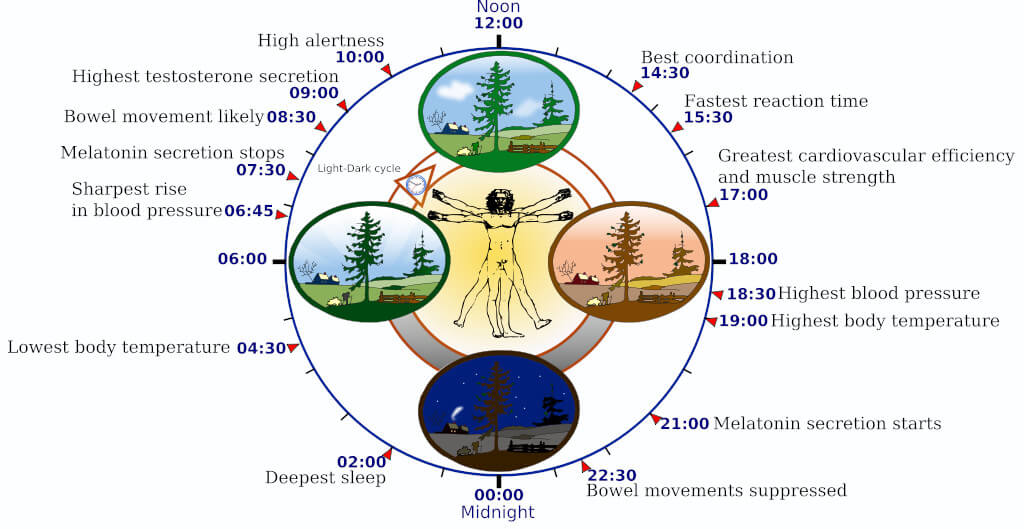
Examples of endogenous pacemakers that control circadian rhythm include systems that release hormones such as melatonin, systems that regulate body temperature, and systems that control metabolism and digestion. The main system that controls circadian rhythms is the suprachiasmatic nucleus (SCN).
These internal processes are influenced by exogenous zeitgebers – perhaps the most obvious of which is sunlight. For example, the darkness of night is thought to trigger melatonin release, which makes you feel tired and want to go to bed.
Key study: Czeisler et al (1982)
Aim
Czeisler et al (1982) aimed to investigate whether altering shift-work schedules to better fit the principles of circadian rhythms could reduce the negative effects of shift work on workers. In particular, the researchers investigated whether changing the direction (phase-advance to phase-delay) and frequency (7 vs. 21 day cycles) of shift rotations could improve workers’ sleep and satisfaction with their work schedules.
Method
The study was conducted at a potash production plant in Utah, USA, where workers had been using a rotating shift system.
The researchers studied 153 male employees. Of these, 85 were rotating shift workers and 68 were workers whose shifts did not rotate (i.e. a control/comparison group).
The rotating shift workers originally worked on a phase-advance schedule, where their shifts moved progressively earlier. This type of rotation can be difficult for the circadian system because workers have to adjust their sleep–wake cycle to increasingly earlier times.
The researchers introduced a new phase-delay schedule, where shifts moved progressively later instead of earlier. The 85 rotating workers were divided into two groups:
- 33 workers continued to change shifts every 7 days.
- 52 workers changed shifts every 21 days.
The researchers then assessed workers’ sleep, health, and satisfaction with their work schedules. They also examined staff turnover and productivity following the introduction of the new schedules.
Results
- The researchers found that workers generally preferred the new phase-delay schedule to the previous phase-advance schedule.
- The 21-day phase-delay group showed better results than the 7-day phase-delay schedule. Among workers on the 21-day schedule, the proportion who complained that the schedule changed too often fell from 90% before the change to 20% after the new schedule was introduced. This reduction was statistically significant and was not found in the weekly phase-delay group.
- The researchers saw improvements in reported health and job satisfaction of employees and a reduction in staff turnover.
- The researchers also found that productivity at the plant increased following the introduction of the new schedules.
Conclusion
Czeisler et al concluded that shift-work schedules can be designed to better fit the body’s natural circadian rhythms.
In particular, phase-delay rotations with longer intervals between changes appear to be less disruptive than rapidly changing phase-advance schedules. Allowing workers more time to adjust to a shift before changing it again can reduce disruption to their circadian rhythms which may improve sleep, health, and job satisfaction.
Overall, Czeisler et al provides useful evidence that the negative effects of shift work can be reduced by designing work schedules around the body’s natural circadian rhythms. The study is particularly valuable because its findings can be directly applied to the workplace.
Evaluation
Strengths of Czeisler et al (1982):
- Practical applications: The research has clear practical applications because it provides evidence that employers can reduce the negative effects of shift work by designing schedules around workers’ circadian rhythms. For example, employers could use slower, phase-delay rotations and allow workers to remain on the same shift for longer periods. This may have positive effects for employees (e.g. improved health and wellbeing) and employers (e.g. improved productivity and reduced staff turnover).
- Real-world setting: The study was conducted with actual shift workers in a real workplace rather than in an artificial laboratory environment. This gives the research good ecological validity because the findings are directly relevant to the problems experienced by people working shifts.
- Objective measures: Although some measures – such as health and job satisfaction – were based on workers’ self-reports, the researchers also measured outcomes such as staff turnover and workplace productivity. These provide more objective measures of whether the new shift patterns were beneficial.
- Supporting evidence: Later research has supported the idea that shift schedules based on circadian principles can reduce disruption. For example, mathematical modelling research examining different shift schedules supported Czeisler et al’s findings that slower, forward-rotating schedules can be more compatible with human circadian rhythms.
Weaknesses of Czeisler et al (1982):
- Self-report data: Much of the data was collected using questionnaires asking workers about their health and job satisfaction. This brings all the usual issues with self-report measures such as social desirability bias, where workers may have been more likely to report positive experiences after the new schedules were introduced.
- Lack of population validity: The sample consisted of male workers from a single potash production plant in the USA. As such, these findings may not generalise to female workers, workers in other occupations, or workers in other countries and cultures.
- Other explanations: Confounding variables may have affected the results, reducing internal validity. For example, workers may have experienced a Hawthorne effect – changing their behaviour or reporting more positively because they knew they were in a study where their working conditions were being improved. This means that the improvements in health, job satisfaction, and productivity cannot necessarily be entirely attributed to better synchronisation of circadian rhythms.
Infradian rhythms
Infradian rhythms are biological cycles lasting more than 24 hours.
An example of an infradian rhythm is the human menstrual cycle: Women typically ovulate once every 28 days.
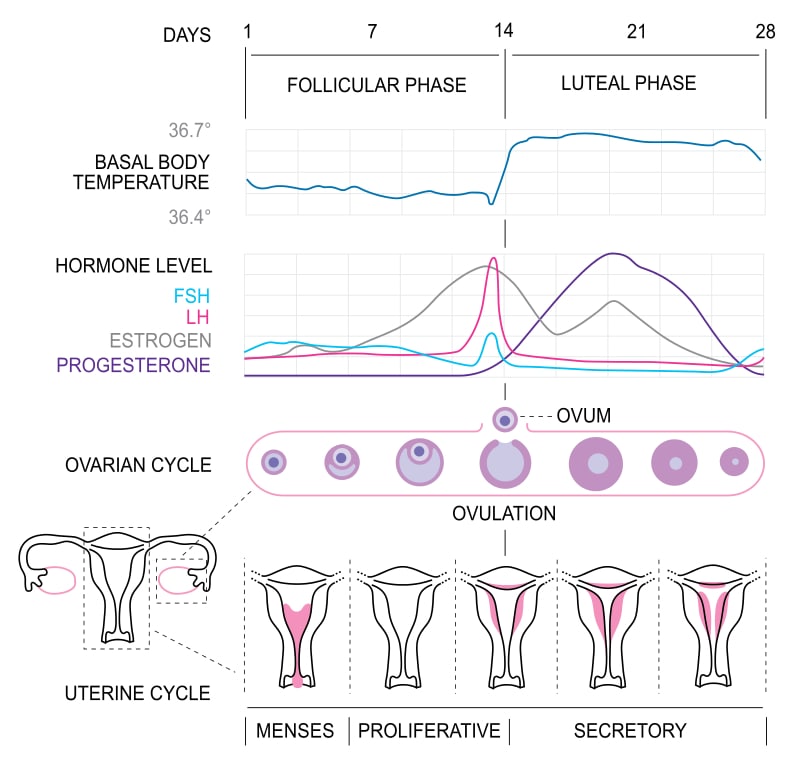
As with circadian rhythms, infradian rhythms are controlled by endogenous pacemakers. For example, hormones such as estrogen and progesterone are crucial to the menstrual cycle.
Infradian rhythms can also be influenced by exogenous zeitgebers. For example, Stern and McClintock (1998) demonstrated that women’s menstrual cycles change when exposed to pheromones from other women.
Ultradian rhythms
Ultradian rhythms are biological cycles lasting less than 24 hours.
An example of an ultradian rhythm is the different stages of sleep: During the night, a sleeping person will typically cycle between five stages:
| Stage | Length | Description |
| 1 | 5-15 minutes | Light sleep. Alpha waves increase and brain activity starts to reduce. Heart rate slows and muscles relax. |
| 2 | 5-15 minutes | Light sleep. Brain activity reduces but with occasional bursts of activity. |
| 3 | 5-15 minutes | Deep sleep. Delta brain waves increase and brain activity is greatly reduced. |
| 4 | ~40 minutes | Deep sleep. Delta waves peak, lowest level of brain activity during the sleep cycle. |
| Rapid eye movement (REM) | >15 minutes | High level of brain activity. Dreams are likely to occur. Body is completely relaxed. |
One complete sleep cycle through all these stages will typically take around 90 minutes. So, during a full night’s sleep, a person may repeat this cycle four or five times.
Disrupted biological rhythms
Biological rhythms can become disrupted when endogenous pacemakers become out of sync with exogenous zeitgebers. Examples of disruption to (circadian) biological rhythms include:
- Jet lag: When a person rapidly travels across several time zones (e.g. for a holiday), their endogenous circadian rhythm remains partly synchronised to their original time zone but exogeneous zeitgebers such as light, meal times, and social activity have changed to match the new time zone.
- Social jet lag: When a person’s sleep–wake pattern changes significantly between weekdays and weekends (e.g. staying up partying on weekends and waking up much later), causing their endogenous circadian rhythm to become out of sync with their normal schedule.
- Shift work: When a person works at times that conflict with their natural sleep–wake cycle (e.g. working at night and sleeping during the day), causing their endogenous circadian rhythm to become out of sync with their working schedule.
Disruption to biological rhythms can have a range of negative effects on behaviour and wellbeing, including:
- Sleep: difficulty falling asleep, staying asleep, or sleeping at appropriate times.
- Alertness: increased tiredness and reduced ability to remain awake and alert.
- Cognitive performance: reduced concentration, attention, memory, and reaction time.
- Mood: increased irritability, low mood, and difficulty regulating emotions.
- Physical health: prolonged disruption may negatively affect physical health and wellbeing.
- Performance and safety: reduced performance at work or school and an increased risk of accidents – particularly when fatigue affects attention and reaction time.
Reducing the effects of disrupted biological rhythms
Disrupted biological rhythms can negatively affect sleep, alertness, mood, and wellbeing. However, understanding how endogenous pacemakers and exogenous zeitgebers control biological rhythms can yield practical ways to reduce these negative effects. For example, melatonin and phototherapy can help reset or adjust the timing of the circadian rhythm following disruption.
Melatonin
Melatonin is a hormone produced by the pineal gland that helps regulate the sleep–wake cycle.
Normally, the suprachiasmatic nucleus (SCN), responds to information about light and darkness in the environment and controls when melatonin is released. Melatonin levels normally rise in the evening when it becomes dark, which signals to the body that it is time to sleep.
When a person’s circadian rhythm has been disrupted, synthetic melatonin can be taken as a medicine to provide an additional melatonin signal at an appropriate time. For example, after travelling across several time zones, taking melatonin in the evening can help signal when the person should sleep. This helps their circadian rhythm adjust to the new time zone.
Melatonin demonstrates how knowledge of the biological mechanisms underlying circadian rhythms can be used to reduce the effects of disruption. Rather than changing an exogenous zeitgeber such as light, melatonin provides an external version of a hormone normally produced by the body to help influence the timing of the circadian rhythm.
Phototherapy
Phototherapy involves exposure to bright light at particular times of day to help adjust the timing of the circadian rhythm.
 Normally, light acts as an exogenous zeitgeber by providing information about the time of day to the SCN. The SCN uses this information to synchronise the body’s circadian rhythm with the external environment.
When a person’s circadian rhythm has been disrupted, phototherapy can provide a signal to the SCN and help reset the circadian rhythm. For example, a shift worker waking up in the middle of the night might use bright light to signal to their body that it is daytime, helping to shift their circadian rhythm towards their night-shift schedule. Or, after travelling across several time zones, exposure to bright light at an appropriate time can help the person’s circadian rhythm adjust to the new time zone.