
In psychology, long-term memory (LTM) refers to the system responsible for storing information over extended periods – anything from a few minutes to an entire lifetime.
The multi-store model of memory sees LTM as one single store. However, this is overly simplistic, as research suggests there are many different types of long-term memory.
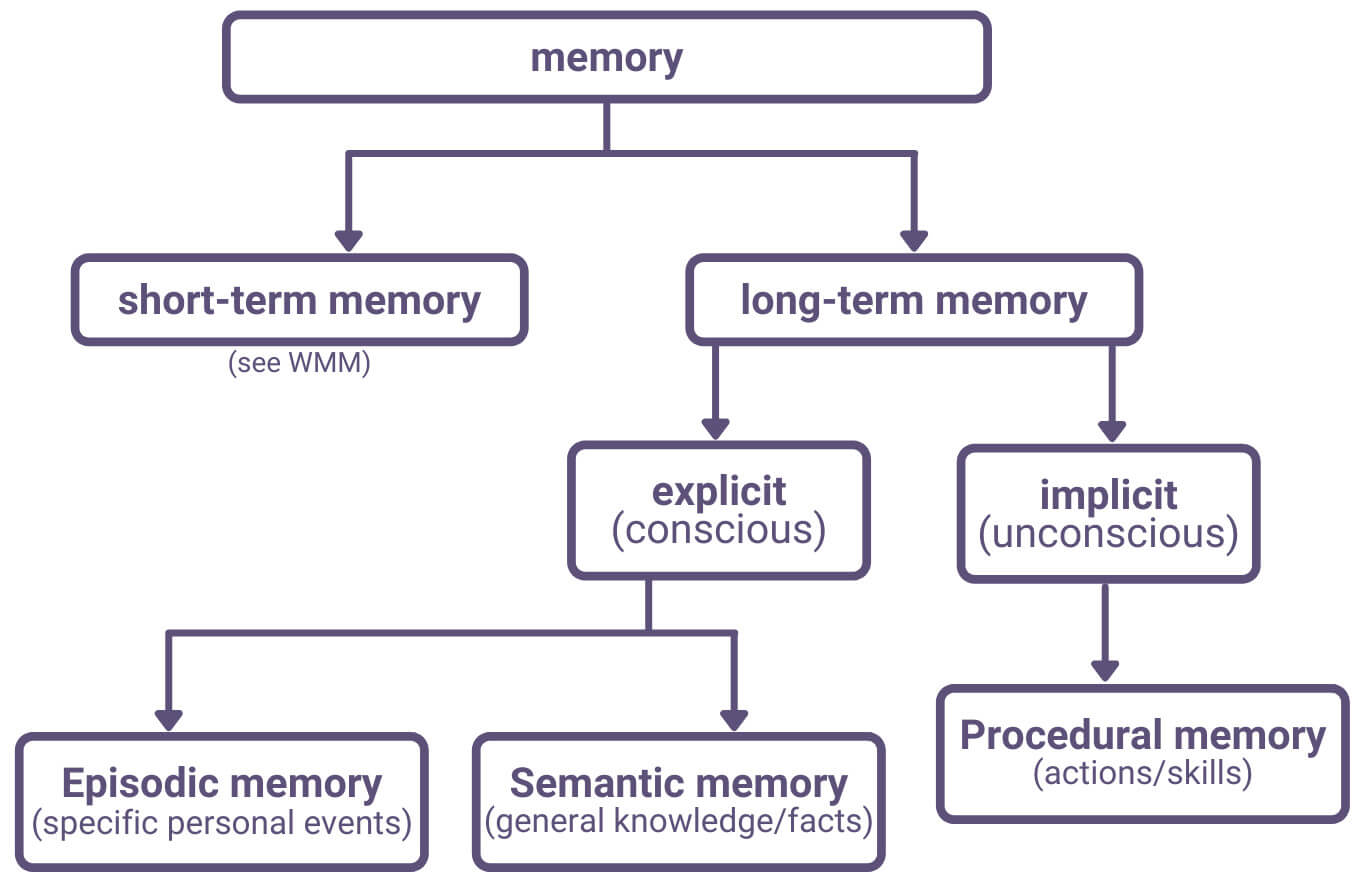
The main distinction in different types of LTM is between explicit and implicit long-term memory:
- Explicit LTM is conscious and easy to put into words.
- Implicit LTM is more subconscious and can’t be put into words.
- For example, skills and abilities such as knowing how to ride a bike (procedural).
Below is a diagram illustrating how these different types of long-term memory are often categorised:
Explicit long-term memory
Explicit memory is memory that you can consciously recall and describe in words (which is why it’s also called declarative).
Explicit memory is usually subdivided into:
- Episodic memory (personal experiences and events).
- Semantic memory (facts, concepts, and general knowledge).
Episodic long-term memory
 Episodic long-term memory covers the story of our lives – things like memories of specific events and the order they occurred in.
For example, remembering your first day at school, or a holiday you went on a few years back, or some embarrassing memory of falling over are all examples of episodic long-term memory. It includes context (e.g. time and place), details of what happened, and the emotions felt.
Strong emotions (positive or negative) cause episodic memories to be coded more strongly. Similarly, if episodic memories are highly processed (for example by rehearsal/repetition) they will be coded more strongly.
Semantic long-term memory
Semantic long-term memory covers meaning, understanding, and general knowledge.
Examples of semantic memory would be facts like “the Battle of Hastings was in 1066” and general understanding of concepts like dogs as 4-legged mammals that run around and bark.
Semantic memories are typically formed over time as we gain knowledge from repeated experiences. They become coded more strongly through regular exposure, usage, and cognitive processing. For example, repeatedly revising key facts for an exam or using a language in daily conversation makes that knowledge easier and faster to retrieve.
Implicit long-term memory
Implicit memory is memory that operates subconsciously, without intentional recall (which is why it’s called non-declarative – you can’t easily ‘declare’ or state it in words).
So, instead of retrieving a thought, implicit memory shows up directly through your actions, skills, or automatic habits. You don’t have to think through the steps, your brain and body just execute them.
The most common form of implicit memory is procedural memory (motor skills and habits), but it also includes classical conditioning (learned emotional or physical responses – think Pavlov’s dogs).
Procedural long-term memory
Procedural long-term memory covers how to do things – actions, skills, abilities, etc.
 For example, remembering how to juggle, ride a bicycle, or drive a car. We begin forming procedural memories from a young age – things like knowing how to walk and talk are learned and then stored as procedural memory.
Although procedural memories are easy to act out, they are difficult/impossible to consciously explain in words. So, unlike semantic and episodic LTM, procedural memory is implicit. The fact that procedural memories do not require conscious thought means they can be recalled while simultaneously performing other cognitive activities – for example, trying to remember what the tallest mountain is (semantic, explicit) while walking along the road (procedural, implicit).
Classical conditioning
Classical conditioning is our learned automatic responses – like unconscious reactions, phobias, and associations formed between different stimuli.
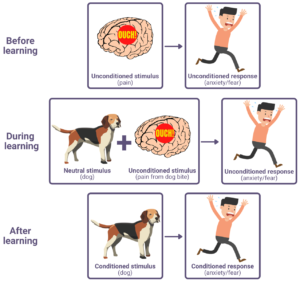 The classic example of this is Pavlov’s dogs: Ivan Pavlov conditioned dogs to salivate at the sound of a bell by repeatedly ringing the bell when presenting them with food. Eventually, the dogs would salivate at the sound of the bell alone without seeing or smelling any food.
But it happens in humans, too. For example, if a person gets bitten by a dog, they may develop a fear of dogs that’s beyond their conscious control. Their subconscious mind associates dogs with the trauma of being bitten, which causes automatic anxiety.
Although classical conditioning strongly influences our behaviour, these behaviours are triggered automatically without any conscious choice or effort. So, just like procedural memory, classically conditioned responses are implicit.
Evaluation
Supporting evidence:
- Retrograde amnesia: Patients with retrograde amnesia may completely forget episodic details of their lives (e.g. childhood events) while still retaining perfect procedural knowledge (e.g. how to ride a bike). This supports the distinction between episodic and procedural memory because it shows that one type of memory can be damaged without affecting the other.
- Neuroimaging: Brain scans (such as PET and fMRI) show that the prefrontal cortex is active during tasks involving episodic memory, whereas the hippocampus and temporal lobes are involved in semantic memory, and the basal ganglia and cerebellum light up during procedural tasks. This supports the idea that these types of memory are biologically distinct areas rather than just theoretical categories.
Weaknesses:
- Unnecessary distinction between episodic and semantic long-term memory: While a distinction between implicit and explicit memory is quite clearly established, the difference within explicit types of long-term memory (i.e. between semantic and episodic) is less clear. Semantic memory seems to originate within episodic memory, and there is significant overlap between the two categories. For example, if you are remembering a semantic fact for a test (e.g. the capital of France) you might do so by recalling your experience (episodic) of looking at a map the night before. This suggests that the distinction between episodic and semantic LTM is unnecessary and overly complicated.
- Overly simplified: On the other hand, you could argue the opposite – that this model is overly simplified and that there are more types of long term memory. For example, some researchers argue that procedural memory consists of multiple distinct sub-systems (e.g. motor skills and cognitive habits).