
Overview – Milgram (1963)
Milgram (1963) is a key study in the social area of psychology that investigated whether ordinary people would obey an authority figure even when instructed to carry out actions that conflicted with their own moral beliefs. By demonstrating that ordinary individuals would inflict severe pain or even death on another person when instructed to do so by an authority figure, Milgram demonstrated the powerful influence of social situations on behaviour and contributed to our understanding of obedience, authority, and the debate between situational and dispositional explanations of behaviour.
You can jump to different sections of this article via the links below:
- Aim
- Method (sampling and procedure)
- Results
- Conclusions
- Evaluation and methodological issues
- Relation to other core social studies
Milgram (1963)
Aim
The aim of the study was to find out to what extent ordinary people would obey an authority figure when told to carry out actions that conflicted with their own conscience.
The inspiration for this study was the events of Nazi Germany. In World War 2, many ordinary German citizens participated in harmful actions – including killing innocent people – simply because they were told to do so by authority figures. Milgram wanted to test whether obedience to authority was a result of something unique about German culture or whether ordinary people from other societies would also obey harmful commands.
Milgram predicted that many participants would refuse to continue following instructions if they believed they were causing serious harm to another person. Before the study took place, 14 psychology students at Yale University were asked to predict the outcome. They estimated that only a very small minority of participants would continue to the maximum shock level (estimates ranged between 1%-3% with an average of 1.2%).
However, Milgram found that a surprisingly high proportion of participants continued to obey the experimenter, with many administering what they thought was a lethal shock to an innocent person.
Method
Participants and sampling
Participants were recruited using volunteer sampling (also known as self-selected sampling). Milgram placed an advert in a local newspaper and sent direct mail invitations asking for volunteers to take part in what was described as a scientific study of memory and learning at Yale University. They were offered $4 for taking part.
The characteristics of the participants were as follows:
- 40 male participants
- Aged 20 to 50 years
- From the New Haven, Connecticut, area in the United States.
These 40 participants came from a wide range of occupations and educational backgrounds – including labourers, salesmen, engineers, teachers, and postal clerks. Milgram deliberately recruited participants from different backgrounds to investigate whether obedience to authority occurred across different sections of society, rather than being limited to a particular social class or profession.
The age and occupations of these participants are summarised in the table below:
| Occupation | 20–29 | 30–39 | 40–50 | % of sample |
|---|---|---|---|---|
| Workers (skilled & unskilled) | 4 | 5 | 6 | 37.5% |
| Sales, business & white-collar | 3 | 6 | 7 | 40.0% |
| Professionals | 1 | 5 | 3 | 22.5% |
| Age distribution | 20% | 40% | 40% | 100% |
Procedure
Although Milgram refers to this study as an experiment, it is technically more accurate to describe it as a controlled observation because there was no independent variable.
Note: In later versions, Milgram did manipulate independent variables – e.g. changing the location (Yale vs. a run-down office), changing the proximity of the experimenter, or altering whether the learner was in the same room. These later variations are experiments but the original 1963 study is a controlled observation.
The study took place at Yale University and used a highly controlled procedure in which participants were led to believe they were taking part in a study investigating the effects of punishment on learning and memory (this is how the study was advertised to participants).
Each participant was introduced to another man (who was actually a confederate) and told that one person would be the ‘teacher’ and the other would be the ‘learner’. They drew lots to decide who would be the teacher and who would be the learner but the outcome was rigged: The participant was always assigned the role of the teacher and the confederate was always assigned the role of learner.
The participant watched the learner get strapped into a chair with electrodes attached to his body. He was told to administer electric shocks to the learner whenever he gave an incorrect answer during a memory task.
Before the experiment began, the participant received a real 45-volt sample shock to increase the belief that the shocks involved in the experiment were real. However, the shocks in the actual experiment weren’t real – the learner was a confederate and only pretended to receive them.
So the experimental setup looked like this:
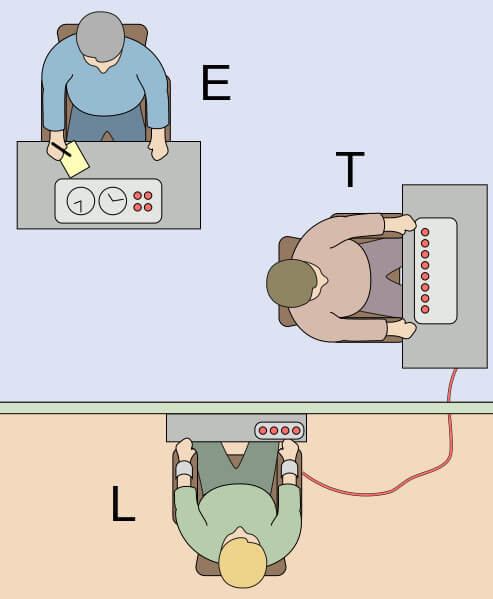
The shock generator had switches ranging from 15 volts to 450 volts, increasing in 15-volt intervals. The participant was told to increase the voltage level by one level each time the learner gave an incorrect answer. The generator had labels on it indicating increasing levels of danger as the voltage increased, ranging from “Slight Shock” at lower levels all the way up to “Danger: Severe Shock” and “XXX” at the highest levels. This setup was designed to make participants believe they were gradually administering increasingly harmful – and eventually lethal – electric shocks to the learner.
During the task, the learner gave incorrect answers according to a pre-decided script. This meant the participant had to administer increasingly powerful shocks after each mistake:
- At 75 volts: The learner began to show signs of discomfort by grunting and reacting to the shocks.
- At 120 volts: The learner complained that the shocks were becoming painful.
- At 150 volts: The learner demanded to be released from the experiment and refused to continue.
- At 180 volts: The learner shouted that he could no longer tolerate the pain.
- At 300 volts: The learner refused to answer any more questions.
- At 315 volts: The learner gave a final protest before becoming silent.
- After 330 volts: The learner stopped responding completely, meaning the participant was instructed to continue administering shocks despite receiving no answers.
If the participant asked to stop the experiment at any stage, the experimenter would reply with one of four successive responses:
- “Please continue” or “please go on”
- “The experiment requires that you continue”
- “It is absolutely essential that you continue”
- “You have no other choice, you must go on”
If the participant continued to refuse after all 4 of these prompts had been given, the experiment was stopped.
- Defiant participant: A participant who stopped administering shocks at any point before 450 volts and in spite of the 4 instructions to continue from the experimenter.
- Obedient participant: A participant who continued administering shocks up to 450 volts and followed the experimenter’s instructions to the end.
After the experiment ended, participants were fully debriefed and informed that the shocks were not real and that the learner was a confederate.
Milgram also conducted follow-up interviews to assess participants’ emotional reactions and ensure that they were not left distressed by the experience. The majority of participants reported that they were glad to have taken part and felt that they had learned something important about themselves.
Results
Milgram found a high level of obedience among participants, in contrast to his prediction.
Out of the 40 participants, 26 (65%) continued to the maximum shock level of 450 volts, despite believing they were administering increasingly severe – and likely lethal – electric shocks to another person. The remaining 14 participants (35%) stopped before reaching 450 volts and refused to continue at some point during the procedure:
| Voltage | Number of participants who stopped at this level |
|---|---|
| 0 volts (refused before any shock) | 0 |
| 15–285 volts | 0 |
| 300 volts | 5 |
| 315 volts | 4 |
| 330 volts | 2 |
| 345 volts | 1 |
| 360 volts | 1 |
| 375 volts | 1 |
| 390 volts | 0 |
| 405 volts | 0 |
| 420 volts | 0 |
| 435 volts | 0 |
| 450 volts (maximum shock level) | 26 |
Many participants showed signs of distress during the procedure – such as hesitation, sweating, and trembling. 14 of the 40 subjects showed “definite signs of nervous laughter”. In the most extreme cases, 3 subjects suffered “full-blown, uncontrollable seizures.” In one case, a participant’s seizure was “so violently convulsive” that the researchers had to halt the experiment.
Despite these obvious signs of stress, most participants continued to follow the experimenter’s instructions.
Conclusions
The results suggest that ordinary people will obey an authority figure even when they believe they are causing harm to another person.
The fact that many participants demonstrated signs of stress – e.g. hesitation, sweating, and nervous laughter – suggests they were experiencing a conflict between their own moral beliefs and the authority figure’s commands. However, despite believing they were causing harm to another person, the presence of a legitimate authority figure appeared to override their personal responsibility and encouraged them to continue obeying.
Situational vs. dispositional factors
This suggests that situational factors can have a powerful effect on behaviour and that obedience is not simply due to dispositional factors:
- Situational factors: Influences external to the person – in this case, the presence of an authority figure and the social context.
- Dispositional factors: Internal characteristics of the participants, such as their personality traits or moral beliefs.
In other words, it’s not just unusually cruel or immoral people who commit harmful acts when told to do so by authority – obedience is strongly influenced by the situation a person is placed in.
However, you could also draw a different conclusion – that individual differences, such as personality, do influence the extent to which people will be obedient. Because although 65% of participants obeyed up to the maximum 450 volts, 35% refused to continue at various points and broke away from the experimenter’s authority.
Explanations of obedience
Overall, Milgram concluded that obedience can be explained by the agentic state:
- Autonomous state: A psychological state where individuals act independently and consciously according to their own moral values and take full personal responsibility for their decisions.
- Agentic state: A psychological shift where individuals see themselves an agent (tool) of an authority figure and thus not personally responsible for their actions.
Milgram argued that we are taught to accept authority in order to keep society orderly. In authoritative situations, people undergo an agentic shift where they relinquish their free will and mentally transfer responsibility to the authority figure. This allows them to obey commands that violate their personal moral compass.
Evaluation
Research methods and techniques
Controlled laboratory setting at Yale University. Although Milgram called an ‘experiment’, it functions more as a controlled observation or baseline study since there was no true independent variable (IV) that was manipulated in the original 1963 paper.
- Strengths: High standardisation and control. Milgram controlled external noise, standardised the prods given by the experimenter (e.g. “Please continue”, “The experiment requires that you continue”, etc.) and fixed the victim’s pre-recorded tape responses and fake voltage shocks.
- Weaknesses: The artificial laboratory environment lacks mundane realism (the task of shocking a stranger for word-pair mistakes does not reflect everyday life activities).
Types of data
Qualitative and quantitative.
- Quantitative Data: Measured as the maximum shock level administered (up to 450V) and the percentage of participants who were fully obedient (26 out of 40 participants).
- Strength: Provides precise, objective, and easily comparable statistics that allow direct comparison across future variations.
- Qualitative Data: Measured via direct observation of participants’ physical and verbal reactions (sweating, trembling, groaning, uncontrollable laughter, lip-biting, and post-experiment interviews).
- Strength: Gives rich, descriptive context proving participants experienced authentic, severe emotional strain and were not simply acting indifferently.
Representativeness and generalisability
Sample Details: 40 males aged 20–50 from New Haven, Connecticut, recruited via a newspaper advertisement and direct mailings, spanning various occupations.
- Weaknesses:
- Sampling bias (self-selection): People who respond to advertisements for psychological research may differ from the general population. For example, volunteer sampling attracts a specific subset of people such as those with free time, high compliance, or interest in research/incentives. As such, results from this sample may not be valid when applied to the general population.
- Androcentric bias: Using an all-male sample means results cannot automatically be generalised to females.
- (Note: Milgram later tested females in Variation 8 and found identical 65% obedience rates, though they reported higher self-reported stress).
- Generalisability: High ecological validity is lacking due to the artificial nature of the task, though Milgram argued the underlying situational forces mirror real-world atrocities (e.g. the Holocaust).
Ethical issues
Milgram’s study was considered so unethical at the time that it prompted an overhaul of psychological ethics guidelines and Milgram’s membership of the American Psychological Association was suspended.
- Deception: Participants were deceived about the true aim (told it was about memory and learning), the allocation of roles (rigged draw so the participant was always the Teacher), and the authenticity of the shocks.
- Right to withdraw: Although participants were technically free to leave, the experimenter’s four standardised verbal prods explicitly pressured them to stay.
- Protection from psychological harm: Participants suffered extreme stress, guilt, and anxiety during the procedure.
- Debriefing and mitigating factors: Milgram conducted thorough debriefings immediately after, re-introduced participants to the unharmed victim (Mr. Wallace), and followed up a year later with a psychiatrist, who reported no long-term psychological damage in 84% of participants.
Validity
- Internal Validity: Are the findings due to the authority figure’s instruction or did another variable cause the result?
- Strengths: High control over extraneous variables ensures the authority figure’s presence caused the outcome.
- Weaknesses: Orne and Holland argued for low internal validity, claiming participants experienced demand characteristics and realised the shocks were fake.
- Response: Qualitative evidence (extreme distress, sweating, nervous laughter) strongly indicates participants believed the setup was genuine.
- Ecological Validity: Do findings translate to the real world?
- Weaknesses: Administering electric shocks in a prestigious university lab under the instruction of a scientist does not reflect how authority operates in real-world contexts (e.g. workplace settings or military command chains).
Reliability
- Internal Reliability: Is the procedure consistent across all participants in this particular study?
- Strength: Highly reliable due to strict standardisation. Every participant experienced identical shock apparatus, scripts, pre-recorded feedback, and verbal prods (e.g. “Please continue”, “The experiment requires that you continue”, etc.) from the experimenter.
- External reliability: Can the study be replicated at a different time and across different groups to produce consistent results?
- Strength: Milgram replicated the baseline procedure multiple times across 18 variations, and independent researchers have successfully replicated the findings cross-culturally and across time (e.g. Burger (2009)), consistently yielding high obedience rates.
Ethnocentrism
The 1963 study was conducted exclusively in the United States (an individualistic Western culture).
- Weaknesses:
- Ethnocentric: The initial findings cannot automatically be assumed to apply to collectivist cultures or other nations where attitudes toward authority and hierarchy differ.
- Cross-cultural replication: Subsequent studies found varying obedience levels globally (e.g. higher obedience rates in Spain and Italy, slightly lower in Australia). This suggests that although obedience is a universal phenomenon, cultural norms influence its intensity.
Evaluation summary table
| Milgram (1963) | |
|---|---|
| Research methods and techniques | Strengths: Highly controlled laboratory setting with standardised procedures. Weaknesses: Artificial setting may have influenced participants’ behaviour. |
| Data types | Collected both quantitative data (maximum voltage reached) and qualitative data (observations of stress), providing both measurable and detailed findings. |
| Representativeness and generalisability | Volunteer sampling may have produced participants who were more willing to follow instructions than the general population. Further, the sample consisted entirely of American men, limiting how well the findings generalise to other cultures and populations. However, the ages and occupations within this group were varied. |
| Ethical issues | Major ethical concerns including deception, psychological harm, and participants believing they had seriously harmed another person. |
| Validity | The realistic laboratory setup (e.g. genuine-looking shock generator, convincing confederate, and authoritative experimenter) meant many participants believed the situation was real, increasing the validity of the findings. However, demand characteristics may have affected some participants. |
| Reliability | High reliability because the standardised procedure can be replicated consistently. |
| Ethnocentrism | The findings may reflect American cultural values and attitudes towards authority, limiting cross-cultural application. |
Relation to social psychology more broadly
Milgram (1963) contributes to the social area of psychology by demonstrating how social situations – particularly the presence of authority figures – can influence behaviour.
The table below summarises how this study compares with other core studies in this area and evaluates its contribution and current relevance:
| Milgram (1963) | |
|---|---|
| How the study relates to the social area of psychology | Milgram investigates how social factors influence human behaviour, specifically how the presence of an authority figure can cause ordinary people to obey instructions, even when these conflict with their own moral beliefs. The study highlights the importance of situational factors, suggesting that behaviour is not only determined by personality or individual characteristics. |
| Comparison with Piliavin et al (1969) |
Similarities:
Both studies investigate how social situations influence behaviour. Milgram examined how the presence of an authority figure influenced obedience, whereas Piliavin examined how social cues (such as victim characteristics and bystanders) influenced helping behaviour. Both suggest behaviour is strongly affected by external social factors, rather than simply individual personality. Differences:
Milgram investigated obedience and harmful behaviour, where participants were pressured to continue an action they believed was wrong. Piliavin investigated helpful behaviour, focusing on when people choose to help others. |
| Comparison with Levine et al (2001) |
Similarities:
Both studies demonstrate that social behaviour is influenced by the wider social environment. Milgram focused on the immediate social situation, whereas Levine examined how cultural norms influence helping behaviour. Both show that behaviour is shaped by factors beyond the individual. Differences:
Milgram studied situational influences within one culture using American participants in a Yale laboratory. Levine investigated cultural differences in helping behaviour across different countries. |
| Contribution to understanding diversity |
Individual differences:
Milgram suggests obedience is not explained by individual personality differences, as people from a wide range of occupations and backgrounds obeyed authority. However, the study did not investigate individual differences in depth and only used male American participants. Social and group differences:
Milgram demonstrates how social roles and relationships influence behaviour – particularly the power of authority figures. However, the sample lacked social diversity because all participants were male and from one particular area of America. Cross-cultural differences:
Milgram suggests obedience is not unique to German culture because similar behaviour occurred among American participants. However, as both these societies share Western individualist values, the findings may not accurately reflect obedience in more different (e.g. Eastern or collectivist) cultures. |
| Usefulness | Milgram’s research has been useful for understanding how authority and social situations influence behaviour. Applications include:
|
| Current relevance | Milgram remains relevant because people continue to encounter authority figures in everyday life, including employers, teachers, doctors, and governments. However, modern society has changed since 1963, including greater awareness of psychological research and ethical standards, which may influence how people respond today. |