
Overview – Levine et al (2001)
Levine et al (2001) is a key study in the social area of psychology that investigated whether a willingness to help strangers varies between people from different cultures. By comparing helping behaviour across 23 cities around the world, the researchers demonstrated that helping behaviour varies between societies. This suggests that cultural and social factors play an important role in shaping prosocial behaviour, rather than being determined entirely by individual personality. The study contributed to our understanding of the influence of culture on prosocial helping behaviour.
You can jump to different sections of this article via the links below:
- Aim
- Method (sampling and procedure)
- Results
- Conclusions
- Evaluation and methodological issues
- Relation to other core social studies
Levine et al (2001)
Aim
The aim of the study was to investigate whether people in some cities are more likely to help strangers than people in other cities and why these differences might occur.
Levine et al were interested in whether helping behaviour is influenced by culture and the wider social environment. Previous research often examined helping behaviour within individual countries or cultures (e.g. Piliavin et al (1969)) but this study was a cross-cultural study that involved 23 cities around the world.
The researchers had 3 main aims:
- To find out whether a person’s tendency to help strangers was consistent across different situations.
- To find out whether helping behaviour varies between cultures, by comparing behaviour across different cities and countries.
- To identify the characteristics of communities where strangers were more or less likely to receive help.
By comparing the results from the three helping situations with other characteristics of the different cities, Levine et al aimed to identify whether differences in helping behaviour could be explained by cultural and social factors, rather than simply by individual differences between people.
Method
Participants and sampling
The researchers used an opportunity sample of members of the public in 23 large cities around the world. Participants were people who happened to be in the locations where the researchers staged the helping situations.
The characteristics of the participants were as follows:
- Participants were ordinary members of the public rather than volunteers who had signed up to take part in a study.
- The study was conducted across 23 cities in different countries, allowing the researchers to compare helping behaviour between different cultures.
- The sample included people from different ages, genders, occupations, and cultural backgrounds (although the researchers were primarily interested in comparing the cities and cultures in which helping behaviour occurred).
The researchers selected this type of sample because they wanted to observe natural helping behaviour in different cultural environments. Using unsuspecting members of the public allowed them to compare how people actually behaved towards strangers rather than relying on questionnaires or unrealistic laboratory conditions.
Procedure
Levine et al conducted a series of field experiments in 23 large cities across the world. Unlike a laboratory experiment, the research took place in real-life public settings, which enabled the researchers to observe spontaneous and realistic helping behaviour.
There were several variables the researchers studied (such as geographical location and community characteristics) to see how they were related to helping behaviour.
However, the main independent variable (IV) the researchers actively manipulated was the type of helping situation. The researchers used three different scenarios requiring helping behaviour. Each scenario involved a researcher creating a situation in which a stranger appeared to need a small amount of assistance:
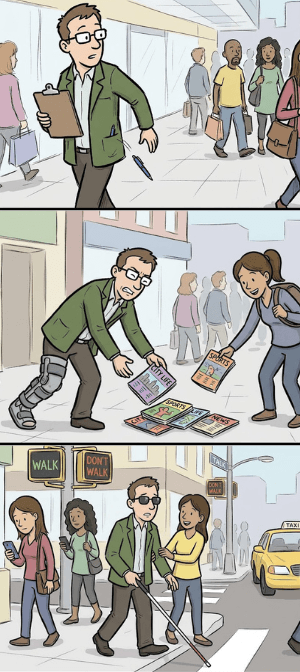 Dropped pen condition: A male researcher walked through a busy pedestrian area and deliberately dropped a pen without appearing to notice. The researchers recorded whether a passer-by noticed the dropped pen and alerted the researcher, picked it up, or simply ignored it.
- Hurt leg condition: A male researcher wore a leg brace and walked with an obvious limp to make it appear that he had a painful or injured leg. He then deliberately dropped a pile of magazines and struggled to pick them up. The researchers recorded whether a passer-by offered assistance or helped him collect the magazines.
- Blind person condition: A male researcher wore dark glasses and carried a white cane, pretending to be blind. He approached a street crossing and appeared to need assistance crossing the road. The researchers recorded whether a passer-by helped him cross the street.
The dependent variable (DV) was helping behaviour, measured by whether the passer-by offered assistance or didn’t offer assistance in each situation.
The researchers carried out the experiments in each of the 23 cities. They attempted to use the same procedures in each location so that differences in helping behaviour could be compared between cities rather than simply being caused by differences in the way the situations were staged.
The researchers then calculated a helping rate for each city based on performance across the three measures. This enabled them to compare the overall tendency of people in different cities to help strangers.
The researchers also examined whether differences between cities could be correlated with wider characteristics of the communities. For example, they compared helping rates with factors such as economic productivity (PPP) and cultural values in order to investigate why some cities appeared to be more helpful than others.
Results
- Levine et al found significant differences in helping behaviour between the 23 cities included in the study.
- However, the pattern varied across the three helping situations. For example, some cities that showed high levels of helping in one situation showed lower levels in another, suggesting that helping behaviour was influenced by the type of situation as well as by cultural differences between cities.
- There was also a significant negative correlation between purchasing power parity (PPP) and helping behaviour. In other words, cities with higher levels of wealth tended to show lower levels of spontaneous helping, while less wealthy cities tended to show higher levels of helping.
- Finally, the researchers found that simpatía cultures were more helpful on average than non-simpatía cultures.
Helping behaviour across the 23 cities
Overall, Rio de Janeiro had the highest level of helping, with an average of 93.33% of people offering assistance across the three situations. At the other end of the scale, Kuala Lumpur had the lowest overall helping rate, at 40.33%.
The table below shows the percentage of people who helped in each of the three situations, as well as the overall average percentage for each city:
| Rank | City and country | Average (% helped) |
z-Score | Dropped pen (% helped) |
Hurt leg (% helped) |
Blind person (% helped) |
|---|---|---|---|---|---|---|
| 1 | Rio de Janeiro, Brazil | 93.33 | 1.66174 | 100 | 80 | 100 |
| 2 | San Jose, Costa Rica | 91.33 | 1.52191 | 79 | 95 | 100 |
| 3 | Lilongwe, Malawi | 86 | 1.14903 | 93 | 65 | 100 |
| 4 | Calcutta, India | 82.67 | 0.91598 | 63 | 93 | 92 |
| 5 | Vienna, Austria | 81 | 0.79946 | 88 | 80 | 75 |
| 6 | Madrid, Spain | 79.33 | 0.68293 | 75 | 63 | 100 |
| 7 | Copenhagen, Denmark | 77.67 | 0.56641 | 89 | 77 | 67 |
| 8 | Shanghai, China | 76.67 | 0.49650 | 75 | 92 | 63 |
| 9 | Mexico City, Mexico | 75.67 | 0.42658 | 55 | 80 | 92 |
| 10 | San Salvador, El Salvador | 74.67 | 0.35667 | 89 | 43 | 92 |
| 11 | Prague, Czech Republic | 75 | 0.37997 | 55 | 70 | 100 |
| 12 | Stockholm, Sweden | 72 | 0.17023 | 92 | 66 | 58 |
| 13 | Budapest, Hungary | 71 | 0.10031 | 76 | 70 | 67 |
| 14 | Bucharest, Romania | 68.67 | –0.06282 | 66 | 48 | 92 |
| 15 | Tel Aviv, Israel | 68 | –0.10943 | 67 | 54 | 83 |
| 16 | Rome, Italy | 63.33 | –0.43570 | 35 | 80 | 75 |
| 17 | Bangkok, Thailand | 61 | –0.59883 | 75 | 66 | 42 |
| 18 | Taipei, Taiwan | 59 | –0.73866 | 65 | 62 | 50 |
| 19 | Sofia, Bulgaria | 57 | –0.87849 | 69 | 22 | 80 |
| 20 | Amsterdam, Netherlands | 53.67 | –1.11154 | 54 | 49 | 58 |
| 21 | Singapore, Singapore | 48 | –1.50772 | 45 | 49 | 50 |
| 22 | New York, United States | 44.67 | –1.74077 | 31 | 28 | 75 |
| 23 | Kuala Lumpur, Malaysia | 40.33 | –2.04374 | 26 | 41 | 54 |
The results show considerable cross-cultural variation in helping behaviour. The difference between the most and least helpful cities was more than 50 percentage points.
However, the results varied between the three situations. For example, New York had a relatively high helping rate in the blind person condition (75%) compared with its dropped pen (31%) and hurt leg (28%) conditions. This shows that helping behaviour was not consistent across different situations.
Community characteristics
The researchers then investigated whether differences in helping behaviour were related to characteristics of the cities and countries in which the study was conducted. The characteristics studied were:
- Population size (for the city, not the country)
- PPP = purchasing power parity (a measure of a country’s wealth)
- Walking speed (note: higher number = slower walking speed)
- Individualism (based on expert rankings of country individualism-collectivism scores).
The table below shows the z-scores – a measure of how far each city’s helping behaviour was above or below the overall average – alongside these community characteristics:
| Rank | City, Country | z-Score | Populati-on size | PPP | Walking speed | Individu-alism |
|---|---|---|---|---|---|---|
| 1 | Rio de Janeiro, Brazil | 1.67 | 5,473,909 | 5,630 | 16.76 | 3.50 |
| 2 | San Jose, Costa Rica | 1.52 | 315,909 | 5,760 | 13.33 | 3.40 |
| 3 | Lilongwe, Malawi | 1.15 | 233,973 | 600 | 3.25 | |
| 4 | Calcutta, India | 0.92 | 4,399,819 | 1,290 | 14.41 | 2.33 |
| 5 | Vienna, Austria | 0.80 | 1,539,848 | 20,230 | 14.08 | 7.80 |
| 6 | Madrid, Spain | 0.68 | 2,976,064 | 14,040 | 13.66 | 5.50 |
| 7 | Copenhagen, Denmark | 0.57 | 619,288 | 20,800 | 12.21 | 7.83 |
| 8 | Shanghai, China | 0.50 | 8,205,598 | 2,510 | 21.65 | 2.17 |
| 9 | Mexico City, Mexico | 0.43 | 8,235,744 | 7,050 | 13.54 | 3.67 |
| 10 | San Salvador, El Salvador | 0.36 | 422,570 | 2,510 | 14.04 | 2.80 |
| 11 | Prague, Czech Republic | 0.38 | 1,216,513 | 7,910 | 13.80 | 5.00 |
| 12 | Stockholm, Sweden | 0.17 | 674,680 | 17,850 | 12.74 | 8.33 |
| 13 | Budapest, Hungary | 0.10 | 2,002,121 | 6,310 | 13.75 | 4.83 |
| 14 | Bucharest, Romania | –0.06 | 2,343,824 | 2,920 | 16.72 | 4.20 |
| 15 | Tel Aviv, Israel | –0.11 | 357,100 | 15,690 | 11.05 | 6.00 |
| 16 | Rome, Italy | –0.44 | 2,693,383 | 18,610 | 12.75 | 5.87 |
| 17 | Bangkok, Thailand | –0.60 | 5,876,000 | 6,870 | 2.50 | |
| 18 | Taipei, Taiwan | –0.74 | 1,769,568 | 13.58 | 3.00 | |
| 19 | Sofia, Bulgaria | –0.88 | 1,114,476 | 4,230 | 15.57 | 4.00 |
| 20 | Amsterdam, Netherlands | –1.11 | 721,976 | 18,080 | 11.46 | 8.17 |
| 21 | Singapore, Singapore | –1.51 | 2,930,000 | 21,430 | 14.74 | 3.17 |
| 22 | New York, United States | –1.74 | 7,311,966 | 25,860 | 12.03 | 9.80 |
| 23 | Kuala Lumpur, Malaysia | –2.04 | 1,145,075 | 8,610 | 2.67 |
This data was then used to identify correlations between the community characteristics and helping behaviour. This allowed the researchers to examine whether cities with particular characteristics tended to have higher or lower levels of helping:
| Community Characteristic | Overall Helping | Blind Person | Hurt Leg | Dropped Pen |
|---|---|---|---|---|
| Population size (city) | –0.03 (23) |
–0.06 (23) |
0.22 (23) |
–0.21 (23) |
| Purchasing power parity (PPP) | –0.43*** (22) |
–0.42*** (22) |
–0.21 (22) |
–0.32* (22) |
| Walking speed | 0.26 (20) |
0.06 (20) |
0.23 (20) |
0.24 (20) |
| Individualism-collectivism | –0.17 (23) |
–0.09 (23) |
–0.21 (23) |
–0.07 (23) |
NOTE: *p <0.15. ***p <0.05, 2-tailed. Sample sizes in parentheses. Statistics for some community characteristics were not available for some countries, resulting in smaller sample sizes for those analyses.
The strongest finding was a negative correlation between purchasing power parity (PPP) and overall helping behaviour (r = −0.43, p <0.05). This means that, within this sample, cities in countries with higher purchasing power tended to have lower levels of helping behaviour. PPP was also significantly negatively correlated with helping in the blind person condition (r = −0.42, p <0.05). There was also a weaker negative relationship between PPP and helping in the dropped pen condition (r = −0.32) but this result was not statistically significant.
The scattergram below provides a visual representation of the relationship between purchasing power parity (PPP) and overall helping behaviour:
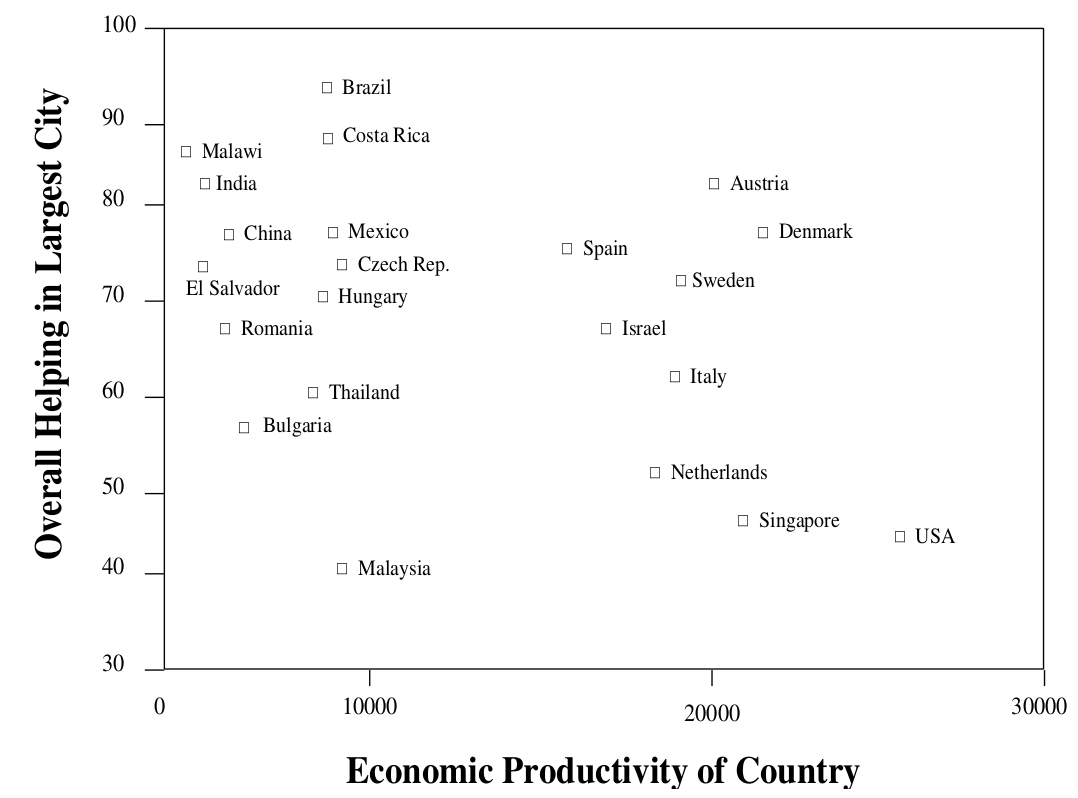
The general pattern of the points shows a negative relationship: as PPP increases, overall helping behaviour tends to decrease. In other words, the cities with higher levels of economic wealth tended to have lower levels of helping.
However, the relationship is not perfect. The points are spread around the trend rather than forming a straight line, showing that PPP cannot completely explain differences in helping behaviour between cities. Other social, cultural, and situational factors are likely to contribute to whether people help strangers.
The other community characteristics showed no statistically significant correlations with overall helping behaviour. Population size, walking speed, and individualism-collectivism were not significantly related to how helpful a city was.
Simpatía cultures
The researchers also compared simpatía cultures with non-simpatía cultures.
Simpatía is a cultural value found particularly in Latin American countries and Spain that emphasises warmth, friendliness, politeness, and positive relationships with others. A person who behaves in this way can be described as simpático.
The researchers predicted that people from simpatía cultures would be more likely to help strangers. This was supported by the results:
- The five simpatía cultures in the study – Brazil, Costa Rica, El Salvador, Mexico, and Spain – had an average helping rate of 82.87%.
- The non-simpatía cultures had an average helping rate of 65.87%.
- This difference was statistically significant: t(21) = 2.65, p <0.02.
Therefore, participants from simpatía cultures were, on average, more likely to help strangers than participants from non-simpatía cultures.
Conclusions
The results suggest that helping behaviour varies between cultures and is influenced by characteristics of the wider social environment.
Factors linked to helping behaviour
Levine et al concluded that helping behaviour is linked with several factors, including:
- Economic productivity: Cities with lower PPP tended to show higher levels of helping behaviour. However, this was simply a correlation and does not necessarily mean that lower wealth causes people to be more helpful. For example, poorer societies may also have traditional values that place greater importance on helping others and that’s why they demonstrate more helping behaviours.
- Type of helping situation: Helping levels varied across the three situations used in the study. This suggests that helping behaviour is not simply a fixed characteristic of a culture but can also depend on the situation in which help is needed.
- Cultural traditions: The five simpatía cultures included in the study – Brazil, Costa Rica, El Salvador, Mexico and Spain – had significantly higher average helping scores than the non-simpatía cultures. Simpatía is a cultural tradition emphasising friendliness, warmth, politeness and positive relationships with others.
Simpatía as an explanation of cultural differences
The researchers suggested that the cultural tradition of simpatía may help explain why Latin American and Spanish cities showed relatively high levels of helping.
Unlike other factors (e.g. the correlation with PPP) simpatía provides a plausible causal explanation for the pattern of results: cultural norms that encourage warmth and positive relationships with others might make people more willing to help strangers.
However, other explanations are also possible. For example, the simpatía cultures in the study were also predominantly Roman Catholic and could be described as having cultures of honour. These factors were not separated from simpatía, so it’s difficult to separate which cultural characteristics are responsible for higher levels of helping.
The researchers therefore concluded that further research is needed to identify exactly why helping behaviour varies between cultures.
Evaluation
Research methods and techniques
Field experiment conducted across 23 cities around the world. Levine et al used standardised field observations to compare spontaneous helping behaviour in different cultures. The researchers created three helping situations: a pedestrian dropping a pen, a person with an apparently injured leg dropping magazines, and a blind person needing help crossing the road.
- Strengths:
- High ecological validity: As a field experiment, the study took place in real-life public settings and participants did not know they were being observed. This means their behaviour was likely to be natural rather than influenced by knowing they were taking part in psychological research.
- Standardised procedures: The researchers used the same three basic helping situations across the different cities. This made it possible to compare helping behaviour between cultures using the same measures
- Cross-cultural comparison: Studying 23 cities allowed the researchers to investigate whether patterns of helping were consistent across different cultural environments rather than drawing conclusions from one society.
- Weaknesses:
- Reduced control over extraneous variables: Because the research took place in natural environments, factors such as weather, time of day, location, crowd size and characteristics of individual pedestrians could not be fully controlled.
- Possible experimenter effects: Different researchers performed the staged helping situations in the different locations. As such, differences in the way the different researchers performed these helping scenarios could have influenced participants’ responses. Therefore, some of the differences in helping behaviour between cities could be due to experimenter effects rather than genuine cultural differences.
- Limited range of situations: Only three relatively minor forms of non-emergency helping were studied. This means the findings may not apply to more serious emergencies or other forms of prosocial behaviour.
Types of data
Mainly quantitative data: Whether people helped in each of the three situations and calculating average helping scores for each city. The researchers also used quantitative measures of community characteristics, including PPP, population size, walking speed and individualism-collectivism.
- Strengths:
- Objective numerical measures: Recording whether someone helped provides clear, measurable data that can be compared between cities.
- Statistical comparisons: The numerical data allowed the researchers to rank the cities and calculate correlations between helping behaviour and community characteristics.
- Multiple measures of helping: Using three different situations allowed the researchers to see whether helping behaviour was consistent across different types of situations.
- Weaknesses:
- Limited depth: Quantitative measures of whether someone helped cannot fully explain why they chose to help or not help.
- Oversimplification: Reducing complex social behaviour to a binary of either helped vs. didn’t help may overlook important differences in how people responded to each situation.
- Note: The original study initially used more detailed scales to measure different levels of helping. For example, in the dropped-pen condition, a person could fail to notice the pen, notice it without helping, call back to the researcher, pick up the pen, or pick it up and catch up with the researcher to return it. However, because some of these categories were difficult to distinguish reliably, the researchers simplified the scoring into whether or not the person helped, producing clearer and more reliable quantitative data.
Representativeness and generalisability
Sample details: The study compared helping behaviour in 23 large cities around the world. Participants were ordinary members of the public who happened to encounter one of the staged helping situations.
- Strengths:
- Large range: Including 23 cities from different parts of the world makes the findings more representative of different cultural environments than a study conducted in only one country.
- Natural sample: Participants were ordinary members of the public rather than psychology students or volunteers recruited for a laboratory experiment. This increases the likelihood that the findings reflect everyday helping behaviour.
- Weaknesses:
- Limited representation within cultures: The study only included one city from most countries. A single city cannot necessarily represent an entire country or culture. Further, focusing on cities may also ignore important differences such as helping behaviour in cities vs. rural contexts.
Ethical issues
Because participants were unaware that they were taking part in psychological research, the study raises potential ethical concerns:
- Deception: Participants were deliberately led to believe that the helping situations were genuine. For example, they believed that a stranger had genuinely dropped something or needed assistance.
- Lack of informed consent: Participants did not know that they were being observed and therefore could not give informed consent before taking part.
- Right to withdraw: Because participants did not know they were being studied, they were unable to choose whether to participate or withdraw their data.
- Protection from psychological harm: The situations were relatively minor and unlikely to cause serious distress.
- Privacy: The researchers observed behaviour in public places and did not identify individual participants in their published results. This reduces concerns about privacy.
Validity
- Internal Validity: Are the differences in helping behaviour genuinely related to cultural or situational factors rather than other variables?
- Standardised procedure: The researchers used the same basic helping situations across the different cities. This makes it more likely that differences in helping behaviour were related to differences between the locations rather than differences in experimental procedures.
- Correlation doesn’t establish causation: The relationship between PPP and helping behaviour was correlational. Although poorer cities tended to show greater levels of helping behaviour, this does not prove that lower wealth causes greater helping. Other variables could explain the relationship (e.g. religious beliefs).
- Ecological Validity: Do findings translate to real-life helping behaviour?
- Field experiment: The study has high ecological validity because it took place in natural public settings and participants believed the situations were genuine. As such, they had to make a real decision about whether to help rather than simply describing what they would do in a questionnaire or acting in an artificial way like they might in a laboratory experiment.
Reliability
- Internal Reliability: Was the procedure consistent across the different cities and situations?
- Standardised procedure: The researchers used standardised helping scenarios and recorded the same basic outcome – whether or not the person helped. This makes comparisons between cities more reliable.
- Natural differences: The natural settings meant that the researchers couldn’t control every aspect of each trial. For example, differences in the surrounding environment could reduce consistency.
- External Reliability: Could the findings be replicated at a different time and with different groups?
- Standardised procedure: The standardised nature of the three helping situations makes the study relatively easy to replicate in other cities or at different times.
Ethnocentrism
The study was specifically designed to investigate cultural differences, making it less ethnocentric than a study conducted within a single culture.
- Strengths:
- Large geographical range: The inclusion of 23 different cities from different parts of the world provided a broad and diverse sample of cultural environments. This enabled the researchers to compare helping behaviour across a wide range of societies, reducing the risk of ethnocentrism.
- Weaknesses:
- Difficulty separating cultural factors: The study cannot completely separate cultural differences from other differences between the countries. For example, the simpatía cultures were also predominantly Roman Catholic and could be described as having cultures of honour. As such, it is difficult to establish which specific cultural characteristics explain their higher levels of helping.
Evaluation summary table
| Levine et al (2001) | |
|---|---|
| Research methods and techniques | Strengths: High ecological validity and standardised procedures allowed natural behaviour to be compared across 23 cities. Weaknesses: Natural settings reduced control over extraneous variables, and experimenter effects may have affected responses. |
| Data types | Mainly quantitative data provided objective measures that could be statistically compared across cities and correlated with community characteristics. |
| Representativeness and generalisability | The study included a wide range of cities. However, one city doesn’t necessarily represent an entire country or culture. Participants were ordinary members of the public, increasing the relevance of the findings to everyday helping behaviour. |
| Ethical issues | Participants were deceived and could not give informed consent or withdraw because they were unaware they were taking part in research. |
| Validity | High ecological validity because helping behaviour was observed in natural situations where participants believed the events were genuine. However, correlations between community characteristics and helping behaviour cannot establish causation, so other variables may explain the differences between cultures. |
| Reliability | Standardised helping situations and consistent measures of whether participants helped made comparisons between cities relatively reliable and allowed the study to be replicated. |
| Ethnocentrism | 23 countries across a broad geographic range reduces the risk of ethnocentrism. |
Relation to social psychology more broadly
Levine et al (2001) contributes to the social area of psychology by demonstrating how cultural and social environments can influence helping behaviour. The study suggests that prosocial behaviour is influenced not just by individual characteristics but also by the wider cultural context in which people live.
The table below summarises how this study compares with other core studies in this area and evaluates its contribution and current relevance:
| Levine et al (2001) | |
|---|---|
| How the study relates to the social area of psychology | Levine et al investigates how social and cultural factors influence human behaviour – specifically whether people from different societies vary in their willingness to help strangers. The study highlights the importance of situational factors (social and cultural environment) in explaining prosocial behaviour and that helping behaviour is not only influenced by individual characteristics. |
| Comparison with Piliavin et al (1969) |
Similarities:
Both studies investigate helping behaviour and demonstrate that prosocial behaviour is influenced by situational factors beyond the individual. Both support the idea that helping behaviour is influenced by the social environment. Differences:
Piliavin investigated helping behaviour within one cultural setting – New York City – whereas Levine et al compared helping behaviour across 23 cities around the world. Piliavin focused on immediate situational factors – such as the characteristics of the victim and presence of other people – whereas Levine examined wider cultural and community factors. |
| Comparison with Milgram (1963) |
Similarities:
Both studies demonstrate that behaviour can be influenced by social factors rather than being determined entirely by individual personality. Differences:
Milgram investigated obedience and harmful behaviour within a single cultural setting using a controlled laboratory procedure. In contrast, Levine investigated social responsibility and prosocial helping behaviour across multiple cultures using naturalistic field observations. |
| Contribution to understanding diversity |
Individual differences:
Levine et al suggests that differences in helping cannot be explained entirely by individual personality because helping behaviour varied systematically between cities. However, the study did not investigate individual personality differences directly so it doesn’t explain why individuals within the same culture may behave differently. Social and group differences:
The study demonstrates that helping behaviour varies between different social environments. Differences in community characteristics – such as economic productivity and cultural traditions such as simpatía – were associated with differences in helping behaviour. Cross-cultural differences:
This is a major contribution of the study. By comparing 23 cities across different parts of the world, Levine demonstrated that helping behaviour varies between cultures. However, the study cannot completely separate specific cultural influences from other differences between societies. |
| Usefulness | Levine’s research has been useful for understanding how cultural and community factors influence helping behaviour. Applications include:
|
| Current relevance | Levine et al (2001) may have reduced temporal validity today because social and economic conditions have changed since the study was conducted (e.g. increased globalisation, social media and changing cultural norms may mean that patterns of helping behaviour today are not identical to those observed in 2001). However, the study may have even greater practical relevance today because increasingly multicultural societies bring people from different cultural backgrounds together, which may influence helping behaviour. |